When the U.S. Army Imported Egyptian Camels to Conquer the American Desert—and It Actually Worked
When the U.S. Army Imported Egyptian Camels to Conquer the American Desert—and It Actually Worked
There's a particular kind of historical tragedy that unfolds not when an idea fails, but when it succeeds brilliantly and then gets destroyed by circumstance. The story of the U.S. Army's camel experiment is exactly that: a genuinely excellent idea that worked perfectly, was killed by terrible timing, and left behind a legacy of wild desert-dwelling camels that confused settlers for decades.
It's the kind of true story that sounds like someone made it up to be funny.
The Problem: Horses Don't Like the Desert
In the 1850s, the United States was expanding westward with the kind of determined optimism that characterized the era. But there was a practical problem: the American Southwest is a hostile environment for horses and mules. The terrain is brutal, water is scarce, and the animals that work so well in temperate climates struggle desperately in desert heat.
The Army knew this. They'd lost countless horses to the unforgiving landscape. Soldiers had died of thirst while trying to keep their mounts alive. Entire expeditions had been delayed or derailed because their animals simply couldn't handle the conditions.
Someone in the War Department—historians credit Secretary of War Jefferson Davis, who would later become president of the Confederacy—had a radical idea: what if the Army used animals that actually evolved to survive in deserts?
What if they used camels?
The Camel Corps Begins
It sounds absurd in retrospect, but it made perfect sense at the time. Camels were literally designed by millions of years of evolution to thrive in arid climates. They could go days without water. They could carry heavy loads. They could navigate rough terrain. They were, in essence, the perfect animal for the job that horses were failing at.
In 1855-1856, the Army authorized a serious, government-funded procurement mission. Agents were sent to Egypt and Turkey to purchase camels and bring them back to America. This wasn't a joke or a publicity stunt—it was a genuine military experiment, backed by federal funds and official War Department approval.
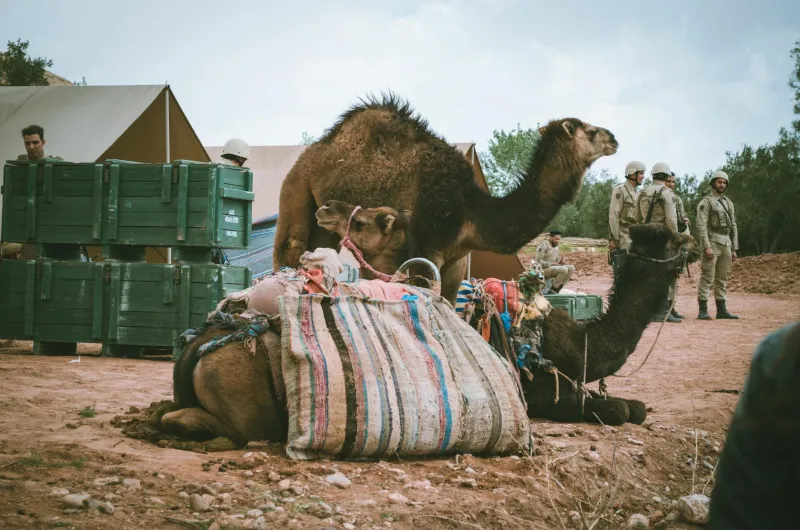
The first shipment arrived in Galveston, Texas, in May 1856. Thirty-four camels disembarked, along with two Arab handlers who knew how to manage the animals. The camels were transported to Camp Verde, a military installation in Texas, where the real experiment would begin.
The Army had high hopes. If this worked, they reasoned, it could revolutionize desert operations.
It worked.
The Surprising Success That Nobody Expected
Within weeks of arriving, the camels proved themselves to be exactly what the Army had hoped they would be. Soldiers who had spent years struggling with horses suddenly found themselves riding animals that could handle the desert with ease. Where horses sweated and stumbled, camels plodded forward steadily. Where mules became exhausted, camels remained calm and capable.
The Army was so impressed that they ordered more. A second shipment of seventy-three camels arrived in 1857. The total camel corps eventually reached about one hundred animals, and military reports from the period are remarkably positive. Camels could carry twice the load of a mule. They required less water. They were stronger and more reliable in extreme heat.
Everything was working perfectly.
In fact, the experiment was so successful that there were serious discussions about expanding it. If the Army could get more camels, they could potentially transform desert operations across the entire Southwest. The camel corps might have become a permanent fixture of American military life. Soldiers might have been training on camels for the next century.
But history had other plans.
The War That Killed a Brilliant Idea
In 1861, the Civil War began, and suddenly the U.S. Army had much bigger problems than optimizing desert logistics. Military attention shifted to the eastern theater. Resources that might have gone toward expanding the camel program were redirected to the conflict. The camels, which had been proving their worth in Texas, were suddenly nobody's priority.
When the war ended in 1865, the Army took stock of its resources and made a decision that would haunt military historians for generations: it sold off the remaining camels. Some were sold to traveling circuses. Some were auctioned to private buyers. Others were simply released into the wild.
And then something remarkable happened.
The Feral Camels of Texas
The released camels didn't die. They didn't disappear. Instead, they adapted to their new environment and went wild, establishing feral populations across Texas and the Southwest. For decades—well into the 20th century—settlers reported sightings of wild camels roaming the desert.
These weren't zoo escapees or circus animals. These were the descendants of the Army's camel corps, now living completely wild in an environment they were perfectly suited for. Ranchers occasionally spotted them. Prospectors reported encounters. Local newspapers printed stories about the "ghost camels" of the desert.
The feral camel population persisted for many decades, though by the early 1900s, most had been killed off by settlers who viewed them as oddities or threats. But for a window of time—a generation or two—the American Southwest had a population of wild camels, a living legacy of an experiment that had worked perfectly but arrived at the wrong moment in history.
What Could Have Been
Historians and military strategists have spent over 150 years wondering what might have happened if the Civil War hadn't interrupted the camel program. Would the Army have continued expanding the camel corps? Could camels have transformed desert warfare? Might the camel have become as iconic in American military history as the horse?
We'll never know.
What we do know is that the camel experiment succeeded on every metric that mattered. The animals were stronger than horses, more efficient than mules, and perfectly adapted to the terrain. The Army's plan was sound. The execution was excellent.
It just arrived at a moment when the nation was about to tear itself apart, and nobody had time to think about the future of desert logistics.
The camel corps stands as a perfect example of a genuinely brilliant idea that was killed not by failure, but by circumstance. It's a reminder that history isn't always determined by what works and what doesn't. Sometimes, it's determined by timing—and sometimes, the best ideas get trampled by bigger events.
The feral camels that roamed Texas for generations were the last monument to the Army's great experiment. They were living proof that the camel corps had worked, that the idea had merit, that a different version of American history might have unfolded if the Civil War had come five years later.
But it didn't. And so the camels became a ghost story—a strange, wonderful, utterly true story of what might have been.