The Checkout Card Detective: How Library Due Dates Exposed a Soviet Spy Ring
The Pattern in the Cards
Margaret Chen had been the head librarian at Millfield Public Library for twelve years when she first noticed something odd about the checkout patterns in 1953. It wasn't anything dramatic—just a subtle rhythm in how certain books disappeared from the shelves and reappeared weeks later, always returned precisely on time, never a day early or late.
What caught her attention wasn't the punctuality—Midwestern library patrons were generally responsible about due dates. It was the books themselves: obscure technical manuals about radio frequencies, industrial chemistry texts that hadn't been checked out in years, and detailed maps of local infrastructure that most residents would never need.
"I kept thinking someone was doing a very thorough research project," Chen would later tell FBI investigators. "But then I realized the same person was never checking out related books. It was like watching a jigsaw puzzle being assembled by different hands."
The Librarian's Investigation
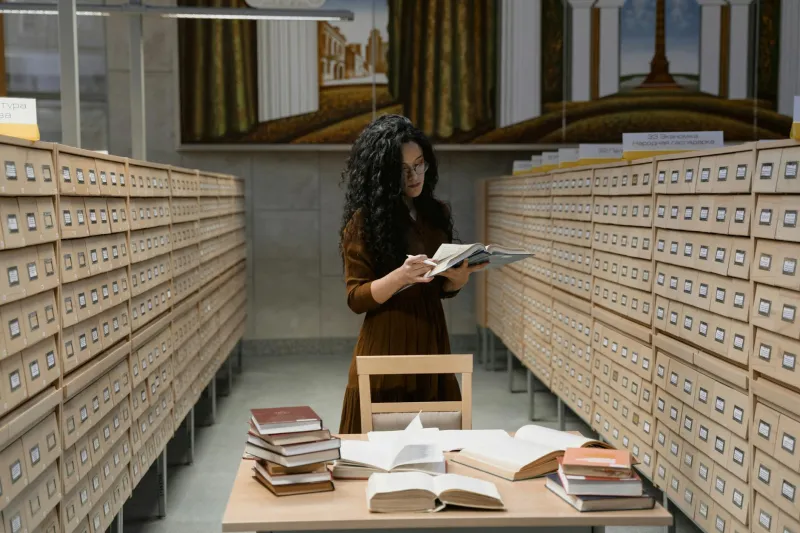
Armed with nothing but her card catalog system and a natural curiosity, Chen began tracking the checkout patterns more carefully. She created her own filing system, noting not just what books were borrowed, but when, by whom, and in what sequence. What emerged was a network of seemingly unconnected library patrons who were systematically accessing information that, when combined, painted a detailed picture of local military installations, communication systems, and industrial capabilities.
The breakthrough came when Chen noticed that checkout dates corresponded with local events. When the nearby Wright-Patterson Air Force Base conducted training exercises, technical manuals about aircraft maintenance would be borrowed. When new radio towers were installed around town, books about radio frequency engineering would disappear from the shelves.
"I felt like I was reading a story written in library cards," Chen recalled. "Each book was a chapter, and someone was using our little library to write a very comprehensive report about our town's secrets."
When the FBI Laughed
In March 1954, Chen made a decision that would seem absurd to anyone who didn't understand the methodical mind of a career librarian. She called the FBI field office in Cincinnati and explained that she believed Soviet spies were using her library to gather intelligence.
The response was exactly what you'd expect when a small-town librarian calls federal agents about suspicious book borrowers. The duty officer politely took her information and promptly filed it under "well-meaning citizen calls." It took three more calls and a detailed written report—complete with checkout charts and borrowing pattern analysis—before Agent Robert Harrison agreed to drive to Millfield and hear her out in person.
"I expected to spend an hour humoring a nervous librarian," Harrison later wrote in his official report. "Instead, I found myself looking at the most comprehensive intelligence analysis I'd seen outside of Langley."
The Unraveling
Chen's meticulous records revealed something that trained counterintelligence officers had missed: a cell of Soviet operatives had been using the library system as a dead drop and intelligence gathering hub for over two years. Different agents would check out specific books, leave coded messages in the margins or between pages, and return them for the next operative to collect.
The beauty of the system was its invisibility. Libraries were public spaces where anyone could spend hours without suspicion. Checkout records were routine administrative documents that nobody examined for patterns. And small-town librarians were the last people anyone would suspect of counterespionage work.
The FBI's subsequent investigation, Operation Bookworm, led to the arrest of seven Soviet agents and the exposure of an intelligence network that stretched across three states. The operatives had been gathering information about military installations, industrial facilities, and communication infrastructure—all through the humble Millfield Public Library.
The Aftermath
What makes Chen's story even more remarkable is how ordinary she remained throughout the entire affair. When the FBI offered to relocate her family for their safety, she declined, saying she had too many library programs to organize. When reporters wanted to interview her about her role in breaking up a spy ring, she insisted on scheduling interviews around story time for the local kindergarten class.
The Soviet agents, it turned out, had chosen Millfield precisely because it seemed like the kind of sleepy town where nothing interesting ever happened. They never imagined that their greatest threat would come from someone whose job was to notice when books weren't where they belonged.
The Legacy of Library Science
Chen continued working as Millfield's head librarian until her retirement in 1978. The FBI occasionally consulted her on other cases involving information gathering patterns, but she always insisted that her methods weren't sophisticated—just the natural result of paying attention to the details that most people overlooked.
"People think librarians just stamp books and shush people," Chen said in a rare interview years later. "But really, we're in the business of tracking information. We notice when patterns change, when people are looking for things that don't quite fit together. Sometimes that skill turns out to be more valuable than anyone expected."
Today, the Millfield Public Library has a small plaque near the checkout desk commemorating Chen's service to national security. Most visitors assume it's honoring a library board member or longtime volunteer. They have no idea they're looking at a monument to one of the most unlikely intelligence breakthroughs in Cold War history—all because one librarian couldn't ignore the feeling that something was off about her checkout cards.