Seven Accidents, Zero Deaths, and One Man Who Turned Catastrophic Bad Luck Into a Safety Empire
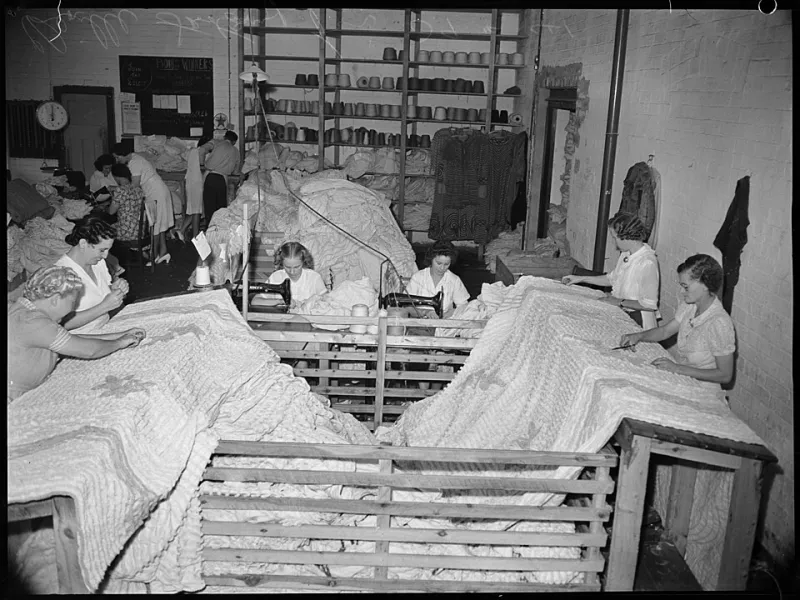
Photo: Unknown authorUnknown author, Public domain, via Wikimedia Commons
There's a version of this story where the man in question is simply the unluckiest person ever to clock into a factory. There's another version where he's the luckiest. The remarkable thing is that both versions are completely accurate.
His name was Chester Greer — a name almost nobody outside industrial safety circles recognizes today, despite the fact that his inventions almost certainly protected someone you know. He was a factory floor worker in the industrial Midwest during the mid-20th century, an era when American manufacturing was booming and workplace safety was, to put it charitably, an afterthought. Greer's career was defined by an extraordinary, statistically bewildering series of workplace accidents, each one survivable, each one different, and each one followed by the same unusual response: he sat down and wrote everything out.
The First Three
The initial accidents happened within the first decade of his working life and could, individually, be chalked up to bad luck. A conveyor belt malfunction that broke two of his ribs. A chemical spill that left him with partial hearing loss in his left ear. A scaffolding collapse that fractured his wrist and put him in the hospital for two weeks.
What made Greer unusual wasn't surviving these incidents — plenty of workers survived injuries in that era, though many didn't. What made him unusual was what he did afterward. He filed detailed written accounts of each accident with his employer, not as formal complaints (though they functioned as those too), but as what he called "failure reports." He wanted to understand, mechanically and procedurally, exactly what had gone wrong. Which component failed. At what point in the process. What the warning signs had been. What a different design might have prevented.
His employers found this mildly irritating. His coworkers found it eccentric. Greer found it necessary.
Accidents Four Through Seven
By the time Greer had survived three serious workplace injuries, he had accumulated a small archive of failure documentation that was, in retrospect, extraordinarily ahead of its time. Modern industrial safety is built on exactly this kind of systematic incident analysis. In the 1950s and early 1960s, it was practically unheard of at the shop floor level.
The next four accidents — a crane cable failure, a press malfunction, an electrical fault, and a fall from an improperly secured ladder — added to both his injury count and his archive. Each one sent him back to his desk, to his notebooks, to the careful and methodical process of writing down everything he could remember about the failure. He interviewed coworkers who had witnessed the incidents. He made rough sketches of the equipment involved. He noted which safety measures had been in place, which had been absent, and which had been present but inadequate.
By his seventh accident — the ladder fall that fractured his pelvis and kept him bedridden for three months — Greer had something genuinely valuable: a detailed, real-world catalog of how industrial equipment failed, told from the perspective of the person who had been standing next to it when it did.
The Notebooks Become Blueprints
Convalescence gave Greer time he hadn't had before. Lying in a hospital bed with a fractured pelvis and nothing but time, he went back through his notes and started looking for patterns. What he found was that several of his accidents shared a common thread: the failure hadn't been inevitable. In each case, a relatively simple mechanical modification — a different locking mechanism, a pressure release valve placed differently, a guardrail with a different load tolerance — would have either prevented the accident entirely or dramatically reduced the severity of the injury.
He started sketching. Then he started building prototypes, crude at first, then progressively more refined. He had no formal engineering training. What he had was seven detailed case studies in what not to do, and a stubborn conviction that better design was possible.
His first commercially viable invention was a cable tension indicator for overhead cranes — a simple device that gave operators a visible warning when a cable was approaching its load limit, before it reached the point of failure. It addressed the exact mechanism that had caused his fourth accident. He patented it in the early 1960s and sold the manufacturing rights to an industrial supplier for modest but meaningful money.
That money funded the next invention. And the next.
Building the Brand
Over the following two decades, Greer developed and patented a series of safety devices that addressed the specific failure modes he had documented across his career. Ladder stabilizers. Chemical exposure indicators. Press guard systems. Each one was grounded in real-world failure data — his own — rather than theoretical engineering models.
The company he eventually founded to manufacture and distribute these devices grew steadily throughout the 1970s and 1980s, riding a wave of increasing federal workplace safety regulation (OSHA was established in 1970, creating enormous demand for exactly the kind of compliance equipment Greer was building). By the time he sold the company in the early 1990s, it was valued at over $300 million.
The Uncomfortable Math
There is something genuinely strange about Chester Greer's story that resists easy framing. He was hurt, repeatedly and seriously, in ways that damaged his body and altered the course of his life. The wealth and recognition that came later didn't undo those injuries. He walked with a noticeable limp for the rest of his life from the pelvis fracture.
But the documentation habit that started as a personal compulsion — a need to understand, to make sense of what had happened to him — turned out to be the most valuable thing he ever did. Not just for himself, but for the workers whose injuries his devices prevented, in factories he would never visit, operated by companies that had no idea a man's seven near-deaths had made their floors safer.
Seven accidents. Zero obituaries. And one of the stranger origin stories American industry has ever produced.