When Military Science Created the World's Bounciest Failure: The Lab Accident That Became America's Favorite Toy

The Wartime Crisis That Changed Everything
By 1943, America had a serious problem. Japanese forces controlled most of Southeast Asia's rubber plantations, and the U.S. military was burning through synthetic alternatives faster than factories could produce them. Every tire, gasket, and seal keeping the war machine running depended on finding a cheap rubber substitute—and finding it fast.
General Electric's research lab in New Haven, Connecticut became ground zero for this desperate search. Engineers worked around the clock, mixing every conceivable combination of chemicals, hoping to stumble onto the formula that would keep American tanks rolling and planes flying.
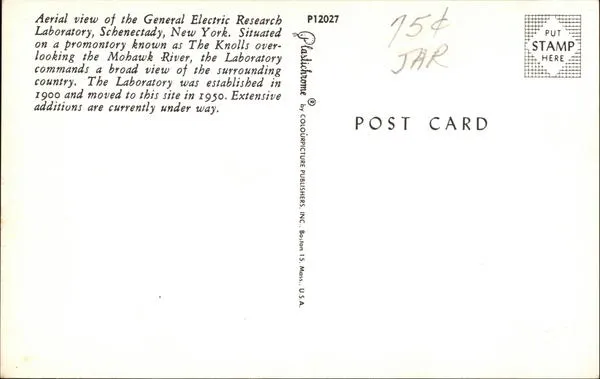 Photo: General Electric's research lab in New Haven, Connecticut, via www.cardcow.com
That's when James Wright, a Scottish engineer with a knack for unconventional thinking, decided to try something nobody else had attempted.
 Photo: James Wright, via gildings.blob.core.windows.net
The Experiment That Went Hilariously Wrong
Wright's idea seemed logical enough: combine boric acid with silicone oil and see what happened. The mixture bubbled, hardened, then turned into something that defied every law of chemistry he understood.
The resulting blob bounced higher than rubber balls. It stretched like taffy but snapped cleanly when pulled hard. Press it against newspaper, and it perfectly copied the ink. Drop it on the floor, and it would bounce in completely unpredictable directions, sometimes hitting the ceiling.
Most importantly for the military's purposes, it was absolutely useless as a rubber substitute.
Wright's supervisors took one look at the bouncing, stretching, copying blob and filed it away as "interesting but impractical." The substance sat in GE's lab for six years, occasionally entertaining visiting scientists but serving no commercial purpose whatsoever.
The Party Trick That Launched an Empire
In 1949, toy store owner Ruth Fallgatter attended a party where someone brought along Wright's forgotten creation as a conversation piece. While other guests politely admired the strange substance's properties, Fallgatter saw something entirely different: the makings of the perfect toy.
She immediately contacted her marketing consultant, Peter Hodgson, who was equally fascinated by the blob's bizarre behavior. They convinced GE to license the formula and began selling one-ounce portions in plastic eggs for $1 each—a premium price for 1950.
Hodgson coined the name "Silly Putty" and marketed it as "the toy with one moving part." The timing couldn't have been better. Post-war America was experiencing an unprecedented boom in disposable income, and parents were eager to buy their children toys that seemed almost magical.
From Laboratory Reject to Cultural Phenomenon
What happened next surprised everyone, including Hodgson. The New Yorker mentioned Silly Putty in their "Talk of the Town" section, and orders exploded overnight. Hodgson's small operation went from selling a few hundred eggs to processing over 250,000 orders in three days.
The Korean War nearly killed the business before it started—the government restricted silicone production for military use, cutting off Hodgson's supply. But when restrictions lifted in 1952, Silly Putty sales resumed their meteoric rise.
By the 1960s, the failed rubber substitute had become a genuine cultural icon. Apollo 8 astronauts took it to the moon to secure tools in zero gravity. Adults discovered it removed lint, pet hair, and dirt from fabrics. Artists used it to create sculptures and prints.
The Accident That Redefined Success
James Wright never received royalties for his accidental invention, but he lived to see his laboratory failure become one of the most recognizable toys in American history. Over 300 million eggs of Silly Putty have sold worldwide, generating hundreds of millions in revenue from a substance originally deemed worthless.
The irony wasn't lost on Wright or his GE colleagues. Their most commercially successful creation was the one that failed to meet its original specifications. Sometimes the best discoveries happen when experiments go completely wrong.
Today, Silly Putty remains virtually unchanged from Wright's original 1943 formula. The same bouncing, stretching, copying blob that frustrated military engineers continues delighting children and adults who appreciate the beauty of a perfectly imperfect accident.
General Electric never did solve their rubber shortage problem through chemistry. But they accidentally created something far more enduring: a toy that proved sometimes failure bounces back in the most unexpected ways.