The Stranger Who Became Family: How One Wrong Turn Led to Four Decades of Holiday Dinners
The Wrong Door at the Right Moment
Sometimes the most profound human connections begin with the simplest mistakes. In September 1952, Harold McKenzie, a traveling pharmaceutical salesman from Akron, Ohio, was running late for his uncle's funeral when he rushed through the wrong doors of Riverside Memorial Home in Cleveland. What followed wasn't just an embarrassing mix-up—it was the beginning of one of America's most unlikely family bonds.
 Photo: Riverside Memorial Home, via www.newyorkitecture.com
 Photo: Akron, Ohio, via img.ctykit.com
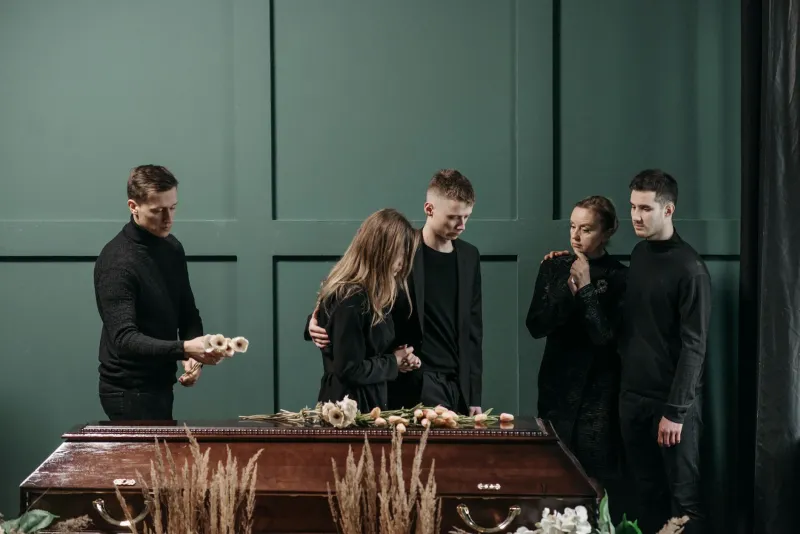
McKenzie had been driving hard from a sales call in Toledo, trying to make it to his Uncle Robert's 2 PM service. Parking outside Riverside Memorial, he hurried inside, straightened his tie, and slipped into the back of a chapel where mourners were gathering around a casket. The deceased was clearly elderly, and McKenzie assumed he'd made it just in time.
What he didn't realize was that Uncle Robert's service was in Chapel B. Harold had wandered into Chapel A, where the Kowalski family was saying goodbye to their patriarch, Stanley Kowalski, a retired steelworker who'd immigrated from Poland in 1923.
An Impromptu Performance That Fooled Everyone
When the funeral director asked if anyone wanted to share memories of Stanley, an uncomfortable silence settled over the room. The Kowalski children—now middle-aged themselves—had been estranged from their father for years. Old grudges and family feuds had left them with more regrets than fond memories to share.
That's when Harold McKenzie stood up.
Mistaking the silence for overwhelming grief, McKenzie walked to the front of the chapel and began speaking about the Stanley he'd never met. Drawing on his salesman's instincts and his genuine memories of his own grandfather (also an immigrant who'd worked with his hands), Harold painted a picture of a man who'd sacrificed everything for his family's future in America.
"Stanley came to this country with nothing but hope," McKenzie told the stunned mourners. "He worked jobs that would break most men's backs, sent his children to schools he'd never attended himself, and built something permanent in a place that was foreign to him. That's the measure of a man—not what he accumulated, but what he gave away."
The Family That Played Along
The eulogy lasted twelve minutes. By the time Harold finished, there wasn't a dry eye in Chapel A—including his own. The Kowalski family sat in stunned silence, not because a stranger had delivered their father's eulogy, but because he'd somehow captured the man they'd forgotten how to see.
Margaret Kowalski, Stanley's eldest daughter, approached Harold after the service. "That was beautiful," she said quietly. "How did you know Dad?"
Harold, still caught up in the emotion of the moment, started to explain—then stopped. Looking at Margaret's tear-stained face, at her siblings standing nearby with expressions he hadn't seen since entering the chapel, he realized something extraordinary had happened. His words hadn't just honored a stranger; they'd given a fractured family permission to remember their father with love instead of resentment.
"We worked together," Harold said simply. "Many years ago."
Four Decades of Sunday Dinners
What began as a white lie became an unspoken family covenant. Margaret invited Harold to join them for dinner after the funeral—"family only," she insisted. When he showed up the following Sunday, she set a place for him again. And again the Sunday after that.
For forty years, Harold McKenzie became an honorary Kowalski. He attended graduations, weddings, baptisms, and birthday parties. The family's children grew up calling him "Cousin Harry." When Margaret's grandson asked why Cousin Harry didn't look Polish like everyone else, the family simply explained that he "took after the other side."
Harold never told them the truth about that September afternoon in 1952. More remarkably, none of the Kowalskis ever asked the obvious questions. How had they lost touch with Cousin Harry for so many years? Why didn't he appear in any family photos? Where exactly had he and Grandpa Stanley worked together?
The Psychology of Chosen Family
Psychologists who've studied the McKenzie-Kowalski story point to it as a perfect example of how families are often built on shared narrative rather than shared DNA. Harold had given the Kowalskis something they desperately needed—a version of their father they could love without reservation. In return, they gave him something he hadn't realized he was missing: a large, boisterous family that gathered every Sunday around Margaret's dining room table.
The arrangement worked because everyone involved chose to make it work. Harold could have confessed his mistake at any point. The Kowalskis could have investigated his claims about knowing their father. Instead, both sides seemed to understand instinctively that some truths are more important than facts.
The Final Sunday
Harold McKenzie passed away in 1992, just three months after Margaret Kowalski. At his funeral—the right one, this time—the Kowalski family filled two entire pews. His obituary listed survivors including "his beloved cousin Margaret and the entire Kowalski family of Cleveland."
Margaret's son Tom delivered the eulogy. "Harry taught us that family isn't just about who you're born to," he said. "Sometimes it's about who shows up when you need them most, even if they're in the wrong place at the right time."
The Legacy of a Beautiful Mistake
The McKenzie-Kowalski story has become something of a legend in Cleveland, passed down through generations as proof that the most meaningful relationships sometimes begin with the most improbable circumstances. It's a reminder that in a world increasingly divided by differences, our common humanity can bridge any gap—even the gap between strangers in a funeral home.
Sometimes the wrong door leads to exactly the right place. Sometimes a mistake becomes the most honest thing you ever do. And sometimes, if you're very lucky, a simple act of kindness toward people you've never met becomes the foundation for the family you never knew you needed.