The Day the Sky Dropped a Piano on an Arizona Farm — and a Festival Was Born
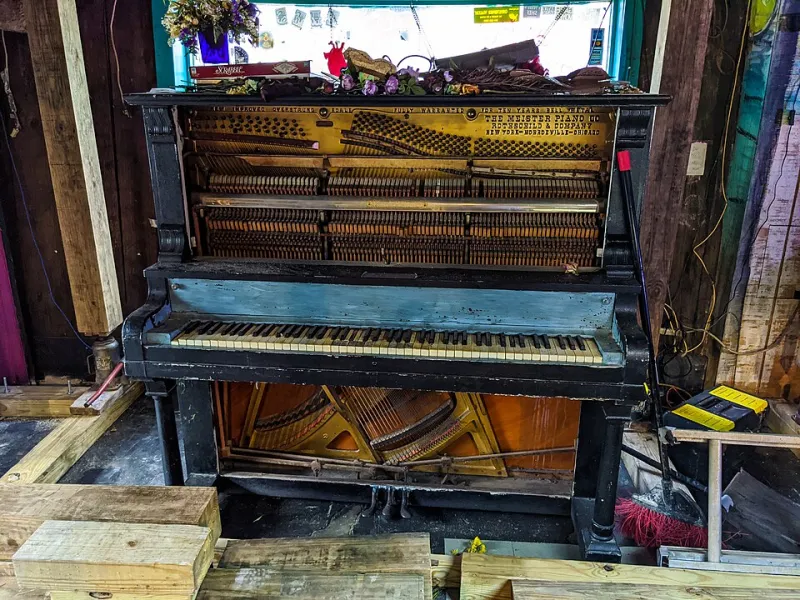
Photo: Bart Everson, CC BY 2.0, via Wikimedia Commons
The Field, the Crash, and the Confusion
There are certain sounds a farmer expects to hear from his back pasture. Wind. Coyotes. Maybe a neighbor's tractor. What nobody in the small farming community outside of Yuma expected on a blistering afternoon in 1954 was the sound of an upright piano meeting the earth at terminal velocity.
But that's exactly what happened.
A military transport plane, flying a supply route across southern Arizona, had been carrying — among more sensible cargo — a piano. Somewhere over the desert, a tie-down strap failed, a cargo door latch gave way, and several hundred pounds of hardwood, wire, and ivory went out the back of the aircraft and into the wild blue yonder.
The pilot, by all accounts, never noticed. The plane continued on its route. The piano, meanwhile, conducted its own unscheduled landing in an alfalfa field, missing a fence post by feet and a sleeping mule by considerably less.
Nobody Claimed It, So the Town Adopted It
Here's where the story gets truly strange — not the accident itself, but what came after.
The farmer, naturally, wanted answers. The Air Force, when contacted, confirmed a cargo discrepancy but couldn't explain how the instrument had ended up precisely in his field. Insurance forms were filed. Letters were exchanged. And then, slowly, everyone with institutional authority simply... moved on.
The town did not.
The piano, cracked and sun-bleached but unmistakably a piano, sat in that field like a monument nobody had ordered. Kids climbed on it. Travelers detoured to see it. And within a couple of years, somebody — the historical society records suggest a feed store owner, though accounts vary — suggested the obvious: if the sky gave you a piano, you throw a festival.
Piano Drop Day: A Tradition Nobody Can Explain and Nobody Wants to Kill
Every year since, the community has marked the anniversary. Early celebrations were modest — a potluck, a brass band, a local pastor who gave a sermon titled, reportedly without irony, "Music From Heaven."
Over the decades, the festival grew its own rituals. There's a pie contest. There's a Honky-Tonk in the Hayfield dance held, weather permitting, around the original piano's remains, which were eventually moved under a pavilion to protect them from monsoon season. There's the traditional reading of the newspaper clipping from 1954, followed by the town's unofficial motto, stitched onto quilts and coffee mugs: "The Sky Provides."
What's remarkable is how little the town has needed the story to make sense. It doesn't. A piano falling out of an airplane and landing safely in a field is not a thing that should happen. The odds are absurd. The physics are unkind. And yet here is a community that decided, collectively, that when reality hands you something inexplicable, the correct response is not confusion — it's a parade.
Why a Town of 300 Refused to Let Go
Sociologists who study small-town identity talk about "founding myths" — the stories communities tell about themselves. Most towns have a battle, a mine, a famous son. This one has a piano that fell out of the sky, and honestly, that's a better story than most.
The festival has survived drought years, highway realignments, and the slow economic drift that emptied so many farm towns across the Southwest. The historical society keeps a scrapbook of every Piano Drop Day going back to the first one, and flipping through it, you see the same faces age decade by decade — new babies held up to see the old piano, teenagers embarrassed in matching festival t-shirts, the feed store owner's grandchildren giving the same speech their grandfather gave.
The Air Force never sent a replacement piano. Nobody in town has ever asked them to. As one longtime resident put it in an interview with the county paper a few years back: "They couldn't give us back the one the sky picked. And anyway, we got the good one."
The Piano Is Still There
You can visit it. The pavilion sits off the county road, past the grain elevators, with a small brass plaque that tells the whole story in four sentences and ends with the town's favorite line: "No one was harmed. The music, however, never stopped."
Believe it or not — that part's up to you — it's true.