The Wrong Patent That Printed Money: How a Naval Engineer's Clerical Blunder Built a Toy Empire
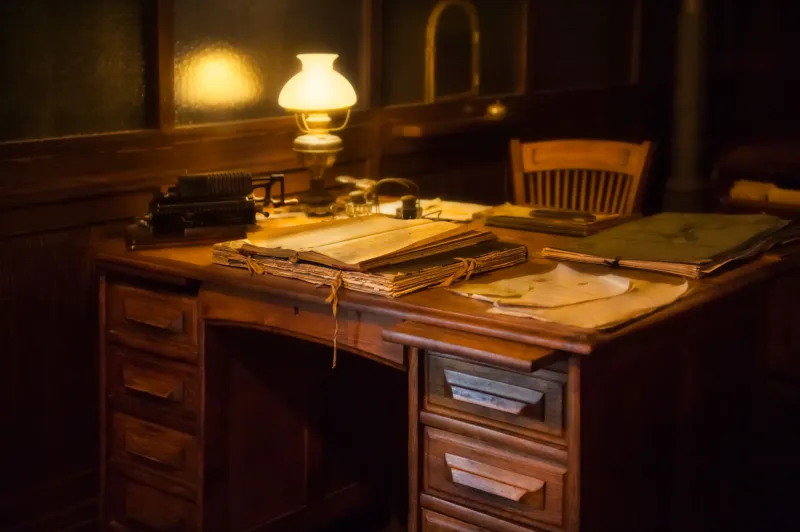
The Wrong Patent That Printed Money: How a Naval Engineer's Clerical Blunder Built a Toy Empire
There's a version of the American Dream where you work hard, innovate brilliantly, and reap the rewards. Then there's the version where you fill out the wrong form, forget about it entirely, and accidentally become a millionaire anyway. Richard James lived the second version — and his story is so improbable it almost feels like the universe was pulling a prank.
A Warship Problem, a Lab Desk, and a Very Confused Filing Cabinet
It was 1943, and James was a mechanical engineer stationed with the U.S. Navy, tasked with solving a frustratingly mundane problem: how to keep sensitive shipboard instruments from rattling themselves apart in rough Atlantic swells. The Navy needed tension springs — specifically calibrated coils that could absorb vibration and keep equipment stable on moving vessels. James was good at his job. He understood springs.
What he was apparently less skilled at was paperwork.
When James filed his patent application for the stabilization device, something went sideways in the documentation. The technical description he submitted didn't accurately capture the stabilizing mechanism he'd designed. Instead, through a combination of rushed drafting and what historians of the period have described as genuinely chaotic wartime administrative conditions, the filing described the dynamic properties of a free-moving coiled spring — one that could transfer its own momentum, walk down inclined surfaces, and essentially propel itself using nothing but gravity and tension.
In other words, he accidentally patented a toy.
Nobody Caught It. Not Once.
Here's where the story gets truly strange. Patent review in the 1940s was, to put it generously, not airtight. The application moved through the system, got its approval stamp, and James received his patent without a single examiner flagging the fact that the described device bore almost no functional resemblance to naval stabilization equipment.
James himself reportedly didn't notice the discrepancy immediately — or if he did, didn't consider it significant. He had a war to help win. The patent sat in a drawer.
It might have stayed there forever, except for a moment in the James household that became one of the most famous origin stories in American toy history. A tension spring fell off his workbench and walked — actually walked, end over end — across the floor. His wife Betty watched it happen and reportedly said something along the lines of: that needs to be a toy.
She was right. And conveniently, her husband already held the patent for it.
From Filing Error to $40 Million
The Jameses launched their toy — the Slinky — at Gimbels department store in Philadelphia in 1945. They sold 400 units in 90 minutes. The patent that Richard James had accidentally misfiled two years earlier was now the legal backbone of one of the most commercially successful toys in American history.
Royalty agreements, licensing deals, and direct sales over the following decades generated what financial historians of the toy industry have estimated at over $40 million in revenue attributable to that original patent filing. The Slinky eventually sold more than 300 million units worldwide. It made the Toy Hall of Fame. NASA used versions of it in zero-gravity experiments. Physics teachers still demonstrate wave mechanics with it in classrooms across the country.
All of it traceable, legally and historically, to a patent application that described something its inventor never actually set out to create.
What the Story Actually Says About Invention
There's a temptation to tell this as a pure comedy of errors — bumbling engineer files wrong form, gets rich anyway, end of story. But the fuller picture is more interesting than that.
Richard James was genuinely skilled. His understanding of spring mechanics was sophisticated enough that even his accidental description captured something real and commercially viable. The "error" wasn't random nonsense; it was a technically coherent description of physical properties he understood deeply, just applied to the wrong device.
That distinction matters. The patent worked because James knew what he was talking about, even when he was talking about the wrong thing.
Betty James, for her part, deserves enormous credit that history has sometimes been slow to give her. She named the toy (from a Swedish word meaning "sleek" or "sinuous"), managed the business after Richard left the family in the mid-1960s to join a religious movement in Bolivia, and kept the company solvent through decades of market shifts. She ran James Industries until selling it in 1998, well into her eighties.
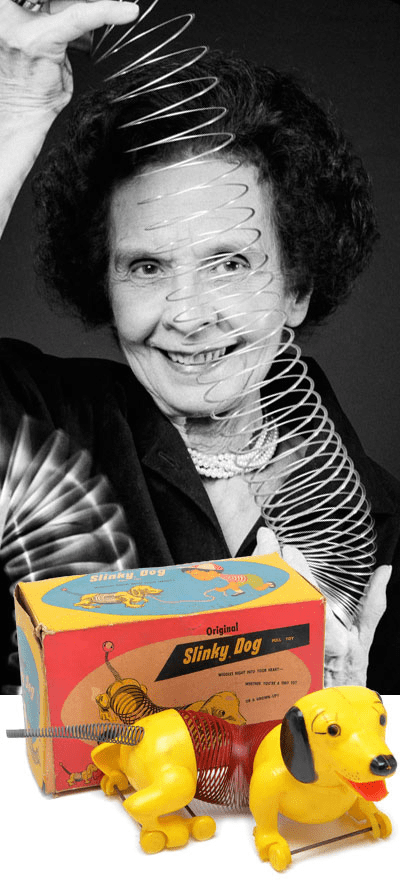 Photo: Betty James, via cdn.philadelphia-future.com
The Paperwork That Changed Playtime
The Slinky's origin story gets told plenty of times — but usually as a tale of happy accident, the spring falling off the shelf, the lightbulb moment. The patent angle is the part that tends to get glossed over, which is a shame, because it's the part that makes the whole thing legally and historically coherent.
Without that misfiled document sitting in a government archive, the toy could have been copied, replicated, and sold by any manufacturer willing to tool up a coiling machine. The accidental patent was the accidental fortune. One clerical error in a Navy engineering office didn't just produce a toy — it produced a protected commercial monopoly on one of the best-selling playthings the country has ever seen.
Somewhere in a federal archive, there's probably still a copy of that original filing, dutifully describing a naval stabilization device that never stabilized anything — except, as it turned out, the financial future of an entire American family.